
Views: 0 Author: Site Editor Publish Time: 2025-12-25 Origin: Site


Choosing hardware for CBD products often trips brands up: users buy the wrong resistance, the device chokes on high-viscosity oil, or a “universal” disposable vape fails with live resin. These mistakes cost time, samples, and reputation. This article explains practical selection criteria — from viscosity matching to resistance and airflow — and gives actionable guidance so procurement, R&D and product teams can select a CBD distillate disposable vape or CBD live resin disposable vape that reliably performs in real-world conditions.
This guide covers: distillate vs live resin characteristics (viscosity, volatility), resistance and voltage matching (including examples like 1.6Ω CBD distillate disposable vape), and mechanical features (airflow, heating element, battery). If you’re a B2B buyer, OEM/ODM manager, or product engineer sourcing disposable vape hardware, this article targets design-to-manufacture decisions and QA checkpoints.
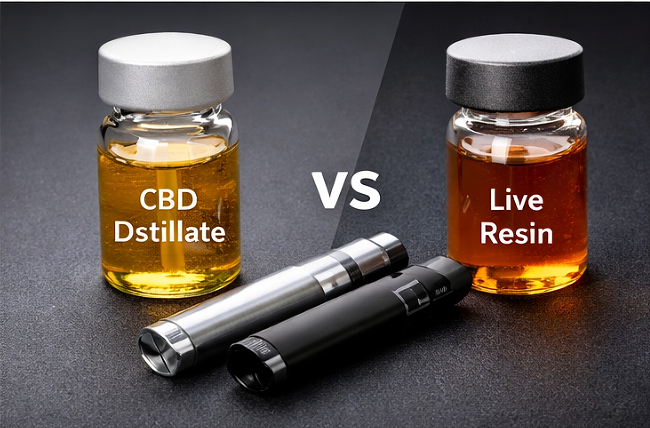
The chief technical difference is physical: CBD distillate is typically low-to-medium viscosity and often lower in volatiles, while live resin retains terpenes and is higher in viscosity and volatility. Selecting a CBD distillate disposable vape for thin distillates but then testing it with a CBD live resin disposable vape expectation will create failures — clogged wicks, spit-back, or under-delivery. For B2B buyers, quantify viscosity (in cP) and provide the supplier with target metrics. Common engineering thresholds: distillates ~50–200 cP; live resin can exceed 500 cP depending on terpene content. A 1.6Ω CBD distillate disposable vape may work well for medium-viscosity distillates at ~3.0–3.6V, but the same 1.6Ω coil often underperforms with high-viscosity live resin unless airflow and heating element surface area are increased.
• Provide three representative oil samples (distillate, mid-viscosity blend, live resin) to the hardware vendor.
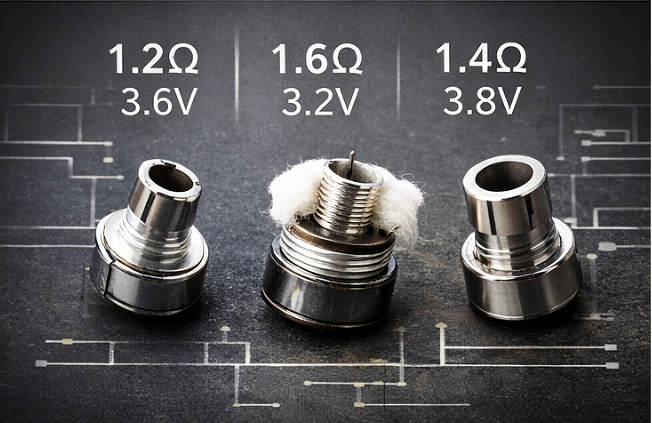
• Request coil resistance matrix: 1.2Ω / 1.4Ω / 1.6Ω / 1.8Ω and corresponding recommended voltage ranges.
• Record draw profile and aerosol yield (mg/puff) during a 10-puff test at standardized draw (4s, 40–55 mL).
These steps let you compare a best CBD distillate disposable vape candidate against a CBD live resin disposable vape baseline and ensure your SKU selection avoids misfit in volume production.
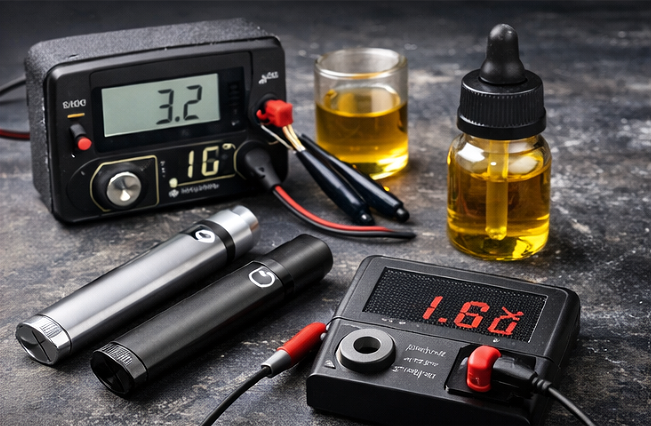
Resistance (Ω) and applied voltage determine coil power (P = V²/R) and surface temperature. A 1.6Ω CBD distillate disposable vape at 3.2V produces ~6.4W — often ideal for medium distillate viscosity, producing stable aerosol without burning terpenes excessively. For live resin, you may need higher power or larger heating surface; a lower-resistance coil (1.2–1.4Ω) or a raised voltage band (3.4–3.8V) can improve vaporization while preventing dry hits.
Ask for exact coil material (SS316 vs Nichrome vs Kanthal), coil surface area, and wick/flow-path design. SS316 offers stable resistance and predictable thermal ramp; cotton-wick vs no-wick (postless) designs have different flow characteristics for terpene-rich live resin.
• Material and spec sheet: coil alloy, wire gauge, and measured resistance tolerance (±5%).
• Recommended voltage window per resistance variant (documented by supplier).
• Airflow aperture sizes and adjustable vs fixed airflow designs.
• Cartridge or chamber geometry — internal volume and oil feed path.
• Battery chemistry and discharge profile (stable voltage under load).
This bullet list is essential when comparing a prospective best CBD distillate disposable vape with alternatives marketed as CBD live resin disposable vape capable devices.
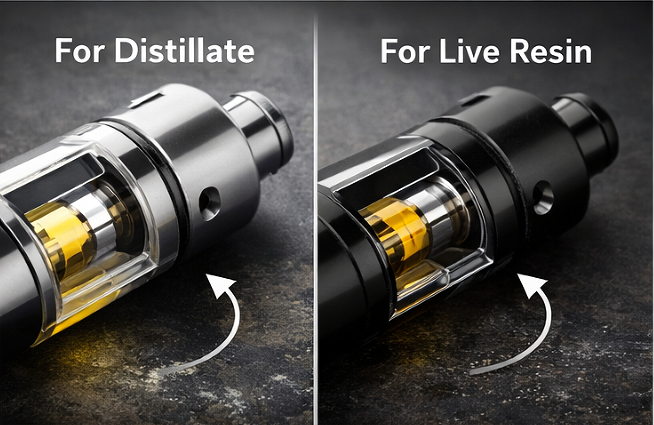
Airflow determines convective cooling and aerosol transport. A constrained airflow can cause overheating with dense live resin; generous ports better support high-viscosity oils. For example, a black 1.6Ω black CBD distillate disposable vape 1.6Ω that uses a narrow aperture may excel with thin distillate but mute terpenes or clog with live resin. Specify target draw resistance (e.g., 40–60 mL per 4-second puff) in vendor RFQs.
When evaluating CBD distillate disposable vape lots at scale, watch for: variability in measured resistance, inconsistent wicking/flow paths, battery failures, and leakage rates during thermal cycling. Ask suppliers for sample batch test reports (30–50 units) and insist on measurable KPIs: mean aerosol yield variance, leakage per 1,000 cycles, and battery voltage drop under load.
A mid-size brand tested two candidates: Candidate A (1.6Ω fixed coil, small aperture) and Candidate B (1.4Ω coil, larger aperture). With a high-terpene live resin blend, Candidate A showed a 27% increase in clog complaints and 18% lower mg/puff; Candidate B maintained stable yield and fewer returns. The outcome: Candidate B was selected for live-resin SKUs; Candidate A was kept for thin-distillate SKUs. This demonstrates why a single CBD distillate disposable vape SKU rarely fits all formulations — plan SKU segmentation accordingly.
Choosing the right device for CBD distillate and live resin requires data-driven alignment across oil rheology, coil resistance and heating profile, airflow geometry, and production QA. A CBD distillate disposable vape optimized around a 1.6Ω coil at a 3.0–3.6V window can serve many distillates, while CBD live resin disposable vape configurations often demand lower-resistance coils, larger heating surfaces, and more open airflow to compensate for higher viscosity and terpene content. For B2B buyers, the actionable steps are clear: supply representative oils, request resistance/voltage matrices, validate aerosol yield under controlled draws, and require batch QC reports before approving tooling or larger orders.
Shenzhen Iplay technology company has invested in iterative testing rigs and matched coil matrices to support both distillate and live resin productization. Their approach emphasizes safety, consistency, and stewardship: designing disposables that reduce malfunction risk, lower leakage rates, and provide predictable aerosol performance while adhering to applicable regulations. Beyond product performance, Shenzhen Iplay technology company recognizes social responsibility — supporting transparent specifications, honest labeling, and cooperation with purchasers to ensure products are used within legal and ethical boundaries.
If you’d like, we can provide a sampling package tailored to your formulations: send three representative oil samples and we’ll return test reports (resistance/voltage mapping, mg/puff data, leakage and user-draw simulation). Contact Shenzhen Iplay technology company for sample requests, technical datasheets, and OEM/ODM discussions — we’ll help you match the right CBD distillate disposable vape or CBD live resin disposable vape to your product line, reducing time-to-market and minimizing post-launch issues.


